Training & Capability Development for Real-World BIM and Engineering Delivery
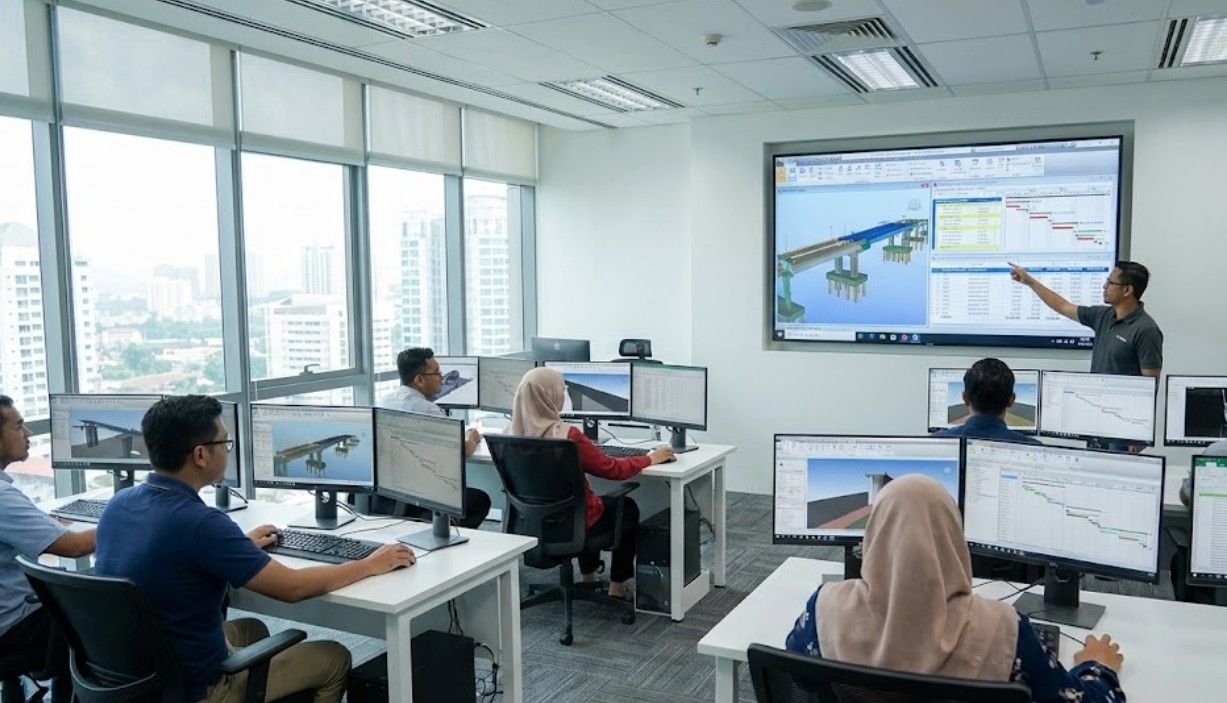
BIM Syncro delivers training and capability development better than the average provider because it treats training as industrial capability building, not classroom software instruction. Its programmes are grounded in real Malaysian projects, real regulatory constraints, and real delivery pressures—so participants leave able to perform, not just certified.
Why “Average Training” Fails the Industry
Most training providers optimise for:
-
Passing exams
-
Completing software tutorials
-
Issuing certificates
That looks good on paper but collapses on site.
The industry problem is not lack of software literacy.
It is the gap between knowing tools and delivering projects—under cost, schedule, regulatory, and constructability constraints.
BIM Syncro was designed to close that gap.
1. Comprehensive Software Training: Tools Taught in Context, Not Isolation
What the average provider does
-
Teaches Revit, Civil 3D, Navisworks, Tekla, or Plaxis as standalone tools
-
Uses generic datasets unrelated to Malaysian conditions
-
Stops at feature walkthroughs
How BIM Syncro does it better
-
Teaches software inside real engineering workflows
-
Uses project-like datasets: roads, drainage, retaining walls, utilities, and industrial layouts
-
Connects tools logically:
-
Civil 3D → earthworks logic
-
Navisworks / Synchro → sequencing and constructability
-
Plaxis / GeoStudio → design decisions, not just plots
-
Result
Participants understand why they model something, not just how. That is the difference between operators and engineers.
2. Project Planning & Simulation: From Gantt Charts to Predictive Thinking
What the average provider does
-
Teaches Microsoft Project or Primavera P6 as scheduling software
-
Focuses on button-clicks and templates
-
Treats 4D/5D BIM as optional “advanced” topics
How BIM Syncro does it better
-
Integrates:
-
Scheduling logic
-
Construction sequencing
-
Earned Value Management
-
4D/5D BIM simulations
-
Participants learn how:
-
Design decisions affect schedules
-
Schedules affect cost exposure
-
Poor sequencing creates downstream risk
Result
Planners and engineers develop predictive judgement, not just timelines.
3. Specialized Design & Analysis Modules: Training That Mirrors Real Scope of Work
What the average provider does
-
Offers fragmented modules
-
Avoids complex or multi-disciplinary problems
-
Simplifies to fit classroom constraints
How BIM Syncro does it better
-
Delivers specialised modules aligned to actual scopes:
-
Roads and highway geometry
-
Stormwater and sewerage systems
-
Water supply networks
-
Retaining walls and slope stability
-
Geotechnical and industrial plant layouts
-
-
Trains participants to:
-
Interpret design intent
-
Balance safety, cost, and constructability
-
Align outputs with approval requirements
-
Result
Graduates can step into live projects without needing to be “retrained” by employers.
4. BIM & Digital Transformation: Adoption, Not Evangelism
What the average provider does
-
Sells BIM as a concept
-
Focuses on clash detection demos
-
Treats digital twin as marketing language
How BIM Syncro does it better
-
Delivers role-based BIM adoption:
-
Engineers
-
Project managers
-
QS and planners
-
Owners and operators
-
-
Teaches:
-
Practical clash resolution workflows
-
BIM-to-approval documentation alignment
-
Digital twin development tied to operations, not hype
-
Result
BIM becomes a working system, not a corporate slogan.
The Real Differentiator: Trainers Who Have Delivered Projects
BIM Syncro’s programmes are led by practitioners who have:
-
Designed infrastructure
-
Managed approvals
-
Faced site constraints
-
Dealt with cost overruns and sequencing failures
This matters because:
-
Theory collapses under pressure
-
Real-world judgement cannot be Googled
-
Good training anticipates failure modes
Conclusion
Average training teaches people how to use tools.
BIM Syncro builds people who can deliver outcomes.
That difference shows up:
-
In employability
-
In project performance
-
In organisational BIM maturity
Training that does not translate into delivery is entertainment.
BIM Syncro’s training is capability engineering—and the industry feels the difference where it counts: on real projects, under real constraints, with real consequences.
Recommended Post

How To Unlock Predictive Intelligence for Operations and Design
BIM Compliance Malaysia