End-to-End Precision for Infrastructure, Industrial and Complex Facilities Projects
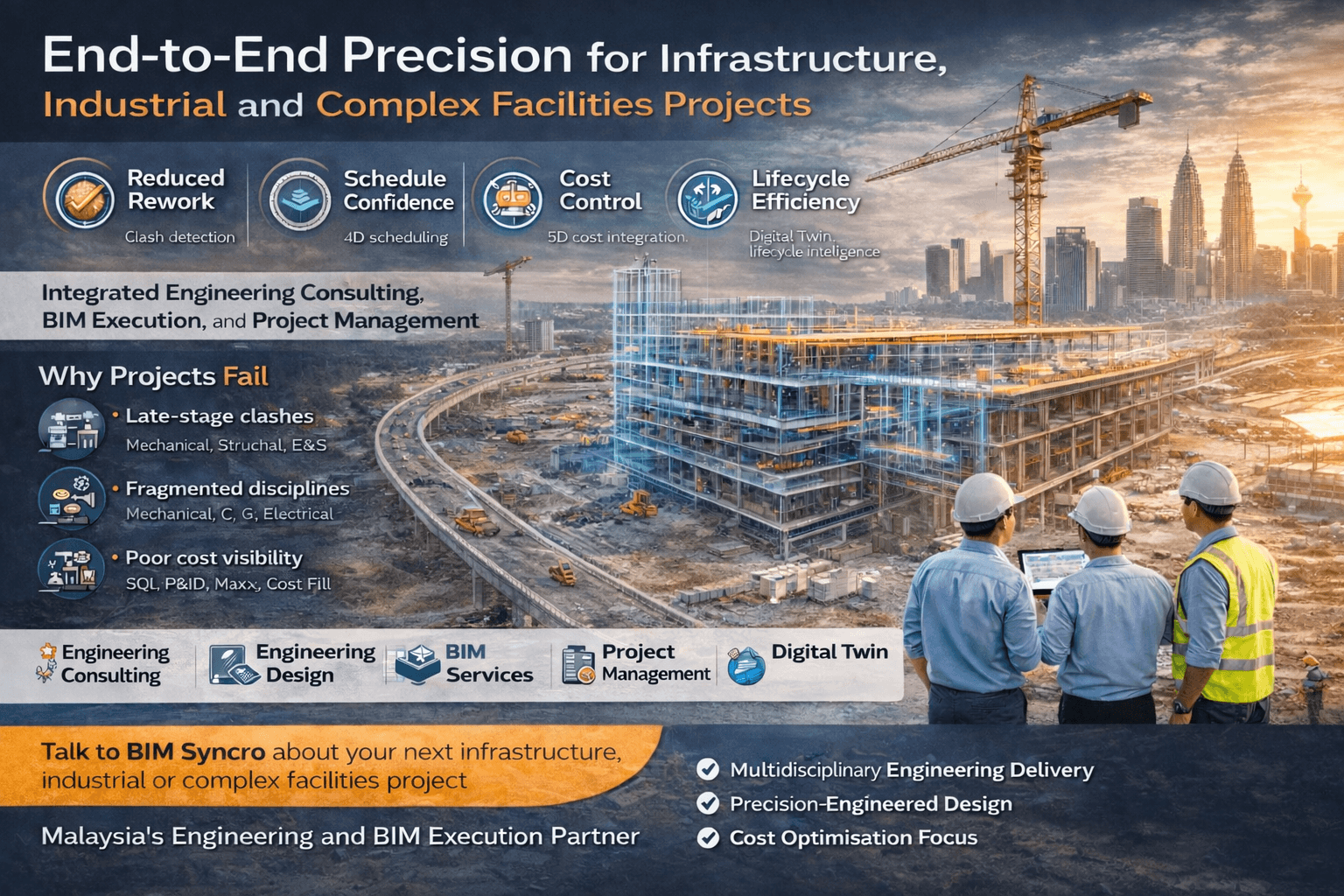
Most projects do not fail at concept—they fail in coordination, sequencing, and execution. Misaligned drawings, late-stage clashes, fragmented engineering inputs, and regulatory delays translate directly into cost overruns and schedule slippage.
BIM Syncro addresses this at the root. By integrating engineering consulting, building information modelling (BIM), project management, and digital twin workflows, projects move from reactive problem-solving to controlled delivery. The outcome is measurable: fewer clashes, faster approvals, predictable schedules, and optimised lifecycle costs.
Why This Matters Now in Malaysia
Malaysia has moved past optional BIM adoption. It is now a compliance and competitiveness requirement, particularly for public and infrastructure projects above RM10 million, with adoption expected to exceed 90% .
What this means in practical terms:
- Contractors without BIM capability lose tenders
- Consultants without coordination workflows create downstream risk
- Asset owners without lifecycle data inherit operational inefficiencies
At the same time:
- Infrastructure, rail, utilities, and industrial investments are scaling
- Regulatory expectations are tightening
- Project complexity is increasing faster than manpower capability
This is where execution discipline—not software—becomes the differentiator.
The Project Problem: Where Most Projects Break Down
Across infrastructure, utilities, and industrial builds, the same failure patterns repeat:
- Clash-driven rework between structural, MEP, and process systems
- Disconnected engineering disciplines operating in silos
- Late-stage cost surprises due to poor 5D integration
- Schedule compression failures due to lack of 4D planning
- Approval delays from incomplete or non-compliant submissions
- No usable asset data at handover
In plain terms:
Most projects still behave like separate spreadsheets pretending to be a system.
How BIM Syncro Solves It
BIM Syncro treats BIM as an execution framework, not a modelling exercise.
Integrated Delivery Approach
- Engineering First
Civil, structural, mechanical, and electrical design developed for constructability and compliance - BIM as Coordination Engine
Federated models ensure multidisciplinary alignment before site execution - 4D Scheduling Integration
Construction sequencing tied to actual build logic, not static timelines - 5D Cost Visibility
Real-time linkage between design and cost reduces budget volatility - Digital Twin Enablement
Asset-ready models for operations, maintenance, and lifecycle optimisation
This is the difference between:
Seeing a building in 3D
vs
Controlling how it gets built, maintained, and monetised
Core Services and Delivery Model
BIM Syncro operates as a multidisciplinary engineering and BIM execution partner:
Engineering Consulting
- Civil & structural engineering design
- Mechanical engineering (HVAC, process systems, manufacturing layouts)
- Electrical engineering (power distribution, control systems, automation)
Building Information Modelling (BIM Services)
- 3D modelling and multidisciplinary coordination
- Clash detection and resolution workflows
- BIM construction management
- LOD strategy and BIM Execution Plans (BEP)
Project Management
- Schedule control using 4D simulation
- Risk mitigation and stakeholder coordination
- Budget control aligned with 5D cost modelling
Digital Twin Integration
- Real-time digital twin environments
- Asset lifecycle intelligence
- Facility management-ready data models
Engineering Outsourcing
- Scalable delivery for G7 contractors and consultants
- Support for infrastructure, industrial, and utility projects
- Cost-efficient engineering resource extension
Why BIM Syncro Is Different
Most firms sell BIM as software capability.
BIM Syncro delivers it as project outcome capability.
What Sets BIM Syncro Apart
- Engineering Detail Design as Core Strength
Designs are buildable, not theoretical - Cost Optimisation Engineered Into Design
Not value-engineered after overruns occur - BIM + Project Management Integration
Not parallel tracks, but one delivery system - Execution Over Visualisation
Focus on delivery certainty, not presentation graphics - Dual Model: Consulting + Capability Building
Clients can outsource delivery or build internal capability
In market terms:
Others train people to use tools
BIM Syncro ensures projects get delivered
Who Should Engage BIM Syncro
BIM Syncro is structured for organisations where project failure has real financial consequences:
Infrastructure & Utilities
- Water, power, waste management, rail systems
- Network expansion, plant upgrades, asset lifecycle optimisation
GLCs & Asset Owners
- Large-scale infrastructure and industrial investments
- Portfolio-level project standardisation
G7 Contractors
- High-rise, infrastructure, industrial builds
- Tender competitiveness through BIM-enabled delivery
Design & Facilities Consultants
- Need for high-precision modelling and coordination
- Integration with asset management frameworks
Industrial & Manufacturing Operators
- Process systems, plant design, production facilities
- Layout optimisation and operational efficiency
If your project involves multiple disciplines, tight timelines, or regulatory complexity, engage BIM Syncro early.
Early-stage coordination reduces downstream cost.
Late-stage fixes multiply it.
Infrastructure and Industrial Projects: Where Precision Matters Most
Infrastructure and industrial projects are unforgiving:
- High capital expenditure
- Complex MEP and process integration
- Regulatory scrutiny
- Long lifecycle implications
BIM Syncro’s approach ensures:
- Constructability is validated before mobilisation
- Coordination issues are resolved before procurement
- Schedules are simulated before execution
- Assets are delivered with usable operational data
This is where digital twin capability moves from “nice-to-have” to strategic necessity.
If you are planning or delivering:
- Infrastructure projects
- Industrial facilities
- Utility systems
- Complex multi-disciplinary developments
Talk to BIM Syncro before coordination risk becomes a cost problem.
Engage early. Deliver with certainty.
Recommended Post